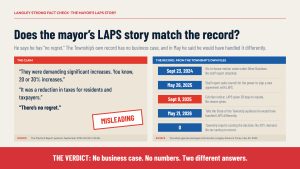

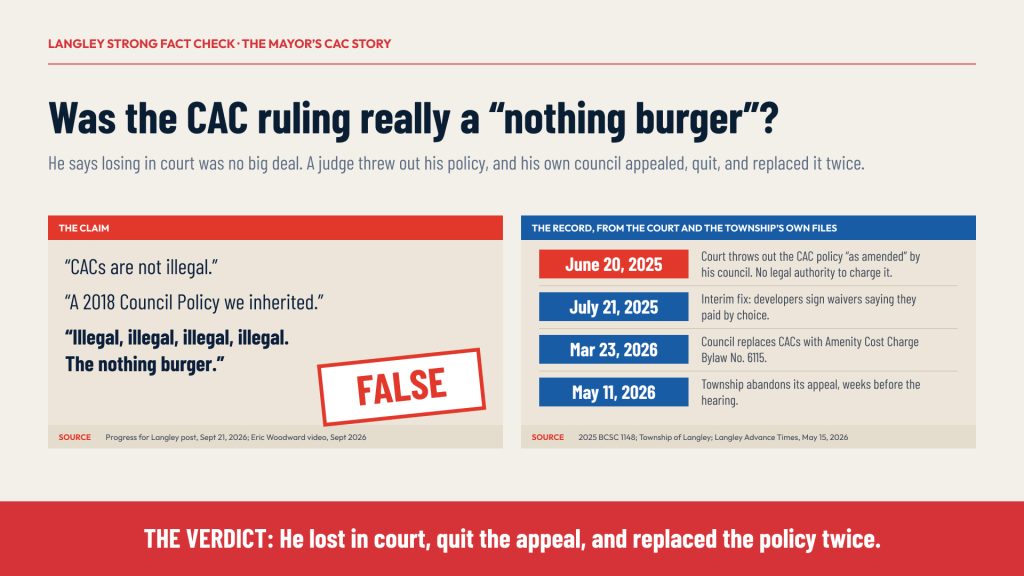
The mayor says the court ruling on his CAC policy was a “nothing burger.” His own council appealed it, dropped the appeal, and replaced the policy twice.
The Claim
Eric Woodward has spent the past week telling residents that his Community Amenity Contribution (CAC) policy was never found unlawful. On September 21, Progress for Langley posted that “CACs are not illegal,” that the court ruling “was directed at a 2018 Council Policy we inherited being too prescriptive, not about Community Amenity Contributions themselves,” that “since this ruling, the Township has collected millions of dollars in CACs,” and that the two people who brought the case “sued you, your family, taxpayers and our communities to not contribute to Langley’s future.” He called the ruling “a nothing burger.”
In a video this week he went further: “Illegal, illegal, illegal, illegal. The nothing burger.” He said his opponents are “rooting against the taxpayer,” that “community amenity contributions are not illegal,” and that “the development industry subsidizes and supports their campaigns.” And when a resident on his own Facebook page repeated the story, Woodward replied: “Another lie to residents. CACs are not illegal, with countless municipalities collecting them every month … If CACs are illegal, how is that possible?”
The Verdict
FALSE. On June 20, 2025, the Supreme Court of British Columbia found that “Langley’s CAC policy, as amended, is a mandatory amenity payment regime beyond Langley’s legal authority” and set it aside as invalid. Not a 2018 policy he inherited: the policy “as amended,” by his council, after he became mayor. The Township appealed, then on May 11, 2026, dropped the appeal, so the ruling stands as the leading BC authority on CACs. His council then wrote an interim policy in July 2025 that makes developers sign waivers saying they paid by choice, and in March 2026 adopted a whole new Amenity Cost Charge bylaw under provincial law to replace CACs. That is not what a council does about a nothing burger. It is what a council does when it lost. Every fact here comes from the court, the Township’s own website, and the law firms that advise municipalities. We linked them all.
Key Points
- The BC Supreme Court, June 20, 2025: the Township’s CAC policy was “a mandatory amenity payment regime beyond Langley’s legal authority,” set aside as invalid. Read the judgment.
- The ruling was about the policy “as amended,” including changes Woodward’s council made from December 2022 to June 2024. It was not a 2018 hand-me-down. Judgment, paras 44, 49 and 96–98.
- The Township appealed, filed its arguments, then abandoned the appeal on May 11, 2026, weeks before the hearing. Langley Advance Times.
- Woodward’s own council replaced the policy twice: an interim “voluntary” scheme with signed waivers in July 2025, then Amenity Cost Charge Bylaw No. 6115 on March 23, 2026. Township of Langley.
- “Millions collected” proves nothing about legality. The court said the same about the old policy: what matters is whether payment is in fact required to get a rezoning, not what the Township calls it. Fasken.
- The lawsuit asked for one thing: a ruling on whether the policy was lawful. It claimed no money from anyone. The plaintiffs were Lorval Developments and Martini Film Studios, not “you, your family, taxpayers.” Langley Advance Times.
- Langley Strong supports growth paying for growth through the lawful tool the Province built for exactly that: Amenity Cost Charges. Province of BC best practices guide.
1. “CACs Are Not Illegal”: The Court Said Otherwise, and He Knows It
Justice Simon Coval’s ruling in Lorval Developments Ltd. v. Langley (Township), 2025 BCSC 1148 is public. He found that the Township’s CAC policy, whatever it called itself, worked as a mandatory charge for rezoning, and that “such a regime cannot be imposed without the appropriate statutory authority which does not exist.” He set the policy aside. The Urban Development Institute summarized it the same week. Fasken, one of the largest municipal law firms in the country, wrote this month that the decision “remains the leading British Columbia authority on the legality of municipal CAC policies” and that “describing contributions as ‘voluntary’ will not prevent a policy from being characterized as a mandatory payment regime where, in substance, payment is effectively required to obtain rezoning approval.”
The leading textbook on the subject, British Columbia Planning Law and Practice, now says the Langley case settled the question: developers “were under practical compulsion to enter into agreements to pay CACs in order to obtain approval of their rezoning applications,” which “amounted to the imposition of a fee for which there was no statutory authority.” Its footnote adds that in a similar case in Manitoba, the municipality was ordered to refund what it collected.
Woodward and his own council appealed the decision. It filed factums, an appeal book and case law over seven months, then on May 11, 2026, walked away before the June hearing. You do not appeal a nothing burger. You do not drop a winning appeal.
2. “A 2018 Policy We Inherited”: The Court Ruled on His Policy
Progress for Langley says the court was only bothered by “a 2018 Council Policy we inherited being too prescriptive.” The judgment says the opposite. The court examined the CAC policy as it stood on June 10, 2024, after a string of amendments the Woodward council passed between December 2022 and June 2024 that added new “lift-based” charges. Those changes are set out at paragraphs 44, 49 and 96 to 98 and Schedule A of the ruling. The judge’s finding, quoted by the Langley Advance Times, is that “Langley’s CAC policy, as amended, is a mandatory amenity payment regime beyond Langley’s legal authority.” As amended. By Woodward’s council. The mayor is blaming the last council for a policy he rewrote and lost on.
3. “Millions Collected Since the Ruling”: The Number Is Not a Defence
The mayor’s proof that CACs are lawful is that money keeps coming in. The Township collected millions under the old policy too, right up to the day the court struck it down. Dollars collected tell you nothing about whether a charge is lawful. The court was clear on what does matter: whether an applicant can get a rezoning without paying. That is why his council’s interim policy, passed July 21, 2025, had developers sign waivers stating the payment was optional. Council staff, asked that night how much had been collected under the struck-down policy, could not say. Councillor Barb Martens said at the same meeting: “I want to ensure we are in compliance with provincial legislation.” That was the point of the lawsuit, and it is the point of this fact check.
There is a lawful way to make growth pay. The Province built it: Amenity Cost Charges under the Local Government Act, set by bylaw, at uniform rates, into a dedicated reserve, with public reporting. Woodward’s council adopted ACC Bylaw No. 6115 on March 23, 2026. If CACs were fine, why replace them? The Township’s own web page now says in-stream applications “may continue as per the Interim Policy” and everything after March 2026 pays ACCs. The mayor is campaigning on a program his own council retired.
4. “They Sued You, Your Family, Taxpayers”: No, They Asked a Judge a Question
The plaintiffs were Lorval Developments and Martini Film Studios, which planned a soundstage near the 216 Street interchange and were told CACs on it would run $32 to $39 million. They did not sue for money. They asked the court to rule on whether the Township had the legal authority to require the payment. The court said it did not. Nobody was sued for a refund, because no CAC had been paid. Woodward calls that “rooting against the taxpayer.” It is a resident going to court to ask whether a rule is legal, and winning when a court said the Township was wrong.
5. “Developers Subsidize Their Campaigns”: Already Checked, Still False
Woodward closes the video by saying the development industry “subsidizes and supports their campaigns.” Corporate and union donations to BC local campaigns have been banned since 2018. Individual gifts are capped. We documented this on September 27, along with Elections BC records showing that Woodward, as a developer, gave $6,600 to the campaigns of the councils he now attacks. Nothing has changed in two days. There is only one developer on Langley Township Council: Eric Woodward.
6. What Langley Strong Actually Supports
Growth should pay for growth. Langley Strong backs Amenity Cost Charges that recover the full cost of the amenities growth needs, set by bylaw under the Province’s best practices guide, so every applicant pays the same posted rate and nobody at Township Hall gets to pick winners and losers one negotiation at a time. That is the lawful version of what Woodward claims he wants.
The Bottom Line
A judge found the mayor’s CAC policy unlawful and set it aside. The mayor appealed, then quit the appeal. His council replaced the policy with waivers, then replaced the waivers with a provincial bylaw. Now, three weeks before an election, he tells residents none of that happened, that the ruling was about someone else’s policy, and that the people who won in court were suing “your family.” The judgment is online. The appeal abandonment is in the newspaper. The new bylaw is on the Township’s own website. He counted on nobody reading them. Bad leaders mislead.
Sources
- Lorval Developments Ltd. v. Langley (Township), 2025 BCSC 1148, June 20, 2025
- Urban Development Institute: Provincial – Legal CAC Decision
- Fasken, September 2026: “BC Supreme Court Sets Aside Langley’s Community Amenity Contributions Policy” (also at Legal 500)
- British Columbia Planning Law and Practice (LexisNexis), §8.45.1
- Langley Advance Times, May 15, 2026: “Langley Township drops appeal of overturned development fees”
- Langley Monitor, July 29, 2025: “Langley’s Development Fees Scrapped After Lawsuit”
- Langley Monitor, June 27, 2026: “Township Drops Appeal After CAC Policy Ruling”
- UDI: Township of Langley Interim Policy for Community Amenity Contributions, July 2025
- Township of Langley: Amenity Cost Charges (Bylaw No. 6115, adopted March 23, 2026)
- Province of BC: Amenity Cost Charge Best Practices Guide
- Langley Strong Fact Check, September 27, 2026: “A Mayoral Master Class on Misleading People”
- Progress for Langley Facebook post, September 21, 2026; Eric Woodward Facebook reply and video, September 28–29, 2026