
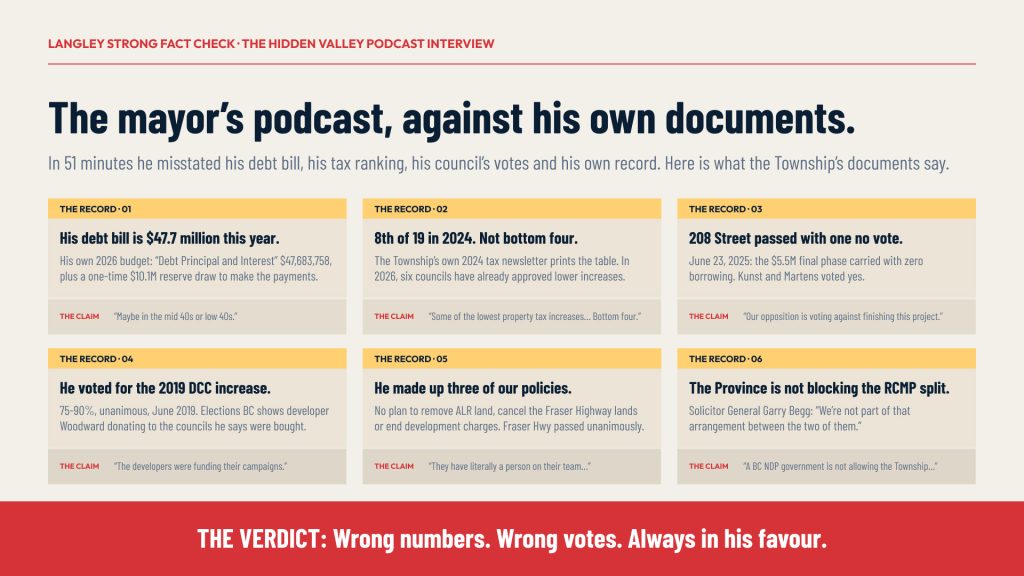
The claim: This month Eric Woodward sat down for a 51-minute interview on the Hidden Valley podcast. Nobody pushed back on a single number, so he supplied a lot of them. He said his debt payments are in the “low 40s.” He said the Township has had “some of the lowest property tax increases in Metro Vancouver this term. Bottom four.” He said his opponents are “voting against finishing” 208 Street, that “only my opposition” wants to pull land out of the ALR, that a Langley Strong candidate is “telling everybody they’re going to cancel” the Fraser Highway employment lands, and that the whole slate is a front for “a handful of developers or billionaire or two.” He said the people attacking him on debt “are the reason we have to borrow in the first place,” because the last council let developers off the hook “because the developers were funding their campaigns.” He said the province is “not allowing” him his own RCMP detachment and that Langley City “has not been a viable partner in policing.” And he told listeners that the Township is still using its CAC program “and will continue to do so.”
The verdict: FALSE, over and over. This is what a master class on misleading people sounds like. The interview is a full hour of a mayor who claims he knows the numbers choosing to give people different ones. His own 2026 budget says the debt servicing bill is $47.7 million, not “low 40s.” And it is headed to $64 million. His own tax newsletter ranks his 2024 increase 8th of 19, not bottom four. His own council minutes show the last phase of 208 Street passed with one vote against and no borrowing at all. The only ALR exclusion of recent years got its final approval from his council, with $22.3 million attached, and he called it “a step in the right direction.” The Fraser Highway plan moved ahead unanimously, with every Langley Strong councillor voting yes. The court struck down his CAC program fifteen months ago and he dropped the appeal. He sat on the council he now blames for not raising development charges, and he voted for an increase just like they did. None of this is hard to find. It is all in documents with the Township of Langley logo on them. He simply counted on nobody checking. We checked.
Key Points
- The debt bill is $47.7 million this year. His budget says so. He said “low 40s.”
- “Bottom four” tax increases: 8th of 19 in 2024 by the Township’s own count, no better than seventh in 2026.
- The last phase of 208 Street passed with one no vote and zero borrowing. He said the opposition is “voting against finishing” it.
- He was on the council he blames for the development-charge “decade,” and he voted for the 2019 increase.
- The CAC program he says “will continue” was struck down by the BC Supreme Court in June 2025. He dropped the appeal.
- Langley Strong has no plan to remove ALR land, cancel the Fraser Highway employment lands, or end development charges. He made all three up.
- The province is not blocking his RCMP split. The Solicitor General said: “We’re not part of that arrangement.”
1. “Low 40s.” His own budget says $47.7 million.
The host said debt servicing runs about $47 million this year. The mayor corrected him: “a little bit lower than that. Maybe in the mid 40s or low 40s.” The host was right; Woodward was not. The Township’s 2026 operating budget lists “Debt Principal and Interest” at $47,683,758. The 2026 capital budget puts committed annual debt servicing at $47.4 million, $32.6 million on existing debt and $14.8 million on new. To make this year’s payments the Township also had to pull a one-time $10,121,286 from reserves for “Capital Debt Servicing.” The mayor chairs the meetings where these numbers are approved. He knew the figure. He gave a smaller one. Our Growth Pays for Growth fact check already walked through where that $47 million is headed: $64.2 million a year by 2030.
He also told listeners the debt is paid from “$75 to $100 million in development revenues… not property taxes.” The same budget shows $14,187,082 in “Debt Repayment Contributions from DCCs” against $47.7 million in payments. The rest comes from the reserve draw and the tax-supported operating budget. And this council has signed two new loans repaid from general revenue, which is property tax: $8.84 million for the Aldergrove parkade and $14.07 million for culverts, together about $2.9 million a year for ten years. “Not property taxes” is not true.
2. “Bottom four.” Not by the Township’s own count.
The mayor said this term delivered “some of the lowest property tax increases in Metro Vancouver… Bottom four.” The increases were 5.37% in 2023, 6.88% in 2024, 4.50% in 2025 and 3.97% in 2026, about 22% compounded. The Township’s own 2024 property tax newsletter prints the regional table: Burnaby 4.50, White Rock 4.82, Abbotsford 5.12, Port Coquitlam 5.58, Richmond 5.62, Maple Ridge 6.50, Port Moody 6.60, and then Langley Township at 6.88, eighth of nineteen. This year is worse. Six councils have already approved lower 2026 increases: Vancouver 0%, Surrey 2.6%, Burnaby 2.9%, Delta 2.9%, West Vancouver 3.43% and Port Moody 3.95%. Three more proposed lower ones: Port Coquitlam 1.95%, Richmond about 3% and Maple Ridge 3.5%. Langley Township came in at 3.97%. Count it any way you like: seventh at best, tenth more likely, and definitely not bottom four. We took apart his “lowest taxes” graphic two weeks ago. He has moved on to a new version of the same misleading claim.
3. “Voting against finishing” 208 Street. One no vote.
The mayor said “our opposition is voting against finishing this project” and that “it’s because of them that we had to pay more.” The final phase of 208 Street, from 81 to 84 Avenue including the 83 Avenue intersection, came to council on June 23, 2025. The minutes record the motion to pre-approve $5,511,500, paid from road DCCs, the capital projects reserve, the greenway amenity fund and deposits. Result: carried. Opposed: Councillor Richter. Kunst and Martens voted yes. Whitmarsh was not on council yet. No borrowing was involved. What the three Langley Strong councillors did vote against at that meeting was a bundle of five temporary borrowing bylaws for other projects, after a motion to vote on them one at a time was defeated by Woodward’s slate on a tie vote. We covered this exact tactic, the borrowing vote dressed up as a vote against the road, in our schools, fields and roads fact check on September 4. He is still misleading the public about it.
He also said that “7 or 8 years ago it would have been $30 million. And they voted it down as too expensive.” There is no record of a $30 million estimate or of that vote. The staff estimate in July 2018 was $83 million for the whole corridor.
4. The developer “decade.” He was on that council, and he voted for the increase he says never happened.
This is the heart of the interview. The mayor said the previous council “didn’t raise development cost charges for a decade,” that developers “were not paying CACs until 2020,” that the reason was “the developers were funding their campaigns,” and that “the very same people that are attacking me now… are the reason we have to borrow in the first place.” Here is the record. The previous DCC bylaw was adopted in 2012. The update, a 75 to 90% increase, passed first, second and third reading unanimously in June 2019. Councillor Eric Woodward voted for it like everyone else did, including Richter, Kunst and Whitmarsh. The Township’s first CAC policy was adopted July 23, 2018, not 2020. Corporate and union donations to local campaigns have been banned in BC since the 2018 election; individuals can still give up to a capped amount. And he knows that, because he did it as a developer himself. Elections BC’s own records show Eric Woodward, developer, giving $6,600 to different campaigns. He funded the councils he now says were bought. The same records show one developer family giving to nearly every serious candidate in 2018, Eric Woodward included: $6,000 to his campaign, $8,400 to Kunst, $6,000 to Whitmarsh, and money to Froese, Ferguson, Pratt, Long, Dornan and Quaale. If developer money bought a council’s silence, it bought his too.
One more thing he leaves out. The growth that swamped Langley’s infrastructure was not cooked up at Township Hall. Canada added 1.27 million people in 2023, a 3.2% jump and the fastest since 1957. Councils answered the only way a council can: they raised development charges. The 2019 increase was 75 to 90%, unanimous. His own council raised DCCs again in January 2024, by 46 to 81%. That is not a decade of developers running the place. That is two councils, his included, dealing with a federal population surge.
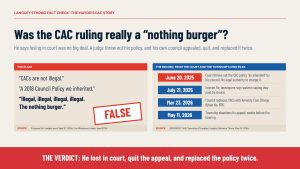
And who are “the very same people”? Of Langley Strong’s council candidates, only Kim Richter and Blair Whitmarsh sat on council before 2018. Jay Lundgren, Lauren Chalus, Shumail Javed and Teresa Townsley have never sat on council. Then there is the program he says the Township “is using… and will continue to do so.” The BC Supreme Court struck down the Township’s CAC policy on June 20, 2025 as a mandatory payment regime beyond the Township’s authority. The Township dropped its appeal on May 11, 2026. Fifteen months on, he tells a podcast audience the program is alive and well. It is not.
5. What Langley Strong “wants.” He made up all three.
The mayor told listeners that “only my opposition wants to” remove land from the ALR. Langley Strong’s platform contains no such proposal. The one ALR exclusion of recent years is the 36-acre Gloucester site, and its story does not help him. The Agricultural Land Commission, not council, took the land out of the ALR, after a court ordered it to reconsider a decade-old application. Council’s job was the rezoning. In May 2022 it passed 5 to 3, with Whitmarsh and Kunst voting yes and Councillor Woodward voting no. Then, as mayor, his council gave it final approval on March 17, 2023. His words that day: “this is a step in the right direction.” Nobody on either slate is campaigning to pull farmland out of the ALR. The one time it happened, both councils had a hand in it, and his signed off last.
He said “our critics are going to cancel” the Fraser Highway Employment Lands plan and that “they have literally a person on their team that’s telling everybody they’re going to cancel it.” False again. The plan moved ahead unanimously on December 15, 2025. Richter, Kunst, Martens and Whitmarsh all voted for it. Langley Strong’s Business platform says exactly what the slate will do with it: “Refine the Fraser Highway Employment Lands Plan to focus predominantly on lands fronting Fraser Highway itself, rather than Old Yale Road or the residential neighbourhoods near it, while maximizing the economic and employment opportunities these lands can provide. Establish design guidelines that support appropriate light industrial uses while providing a thoughtful transition and appropriate buffers to neighbouring residential areas.” Refine is not cancel. Keeping jobs land on the highway and buffers on the neighbourhoods is what residents have asked for.
He also claimed Langley Strong wants to “cease this [development fee] program because a handful of developers or billionaire or two that don’t like it.” Nothing in Langley Strong’s Taxpayers platform ends DCCs, ACCs or other such charges. We do promise a forensic audit in the first 100 days, a public price tag before work begins, and a public debt repayment plan.
6. The RCMP split. The province is not blocking it, and the City paid its share.
The mayor said “they have a BC NDP government that is not allowing the Township of Langley to have what it’s entitled to have under the current Police Act,” and warned of a plan “to forcibly reintegrate the detachment.” No such decision exists. Solicitor General Garry Begg, asked directly in 2025: “This is a contractual arrangement that the City and the Township both have with the same group… We’re not part of that arrangement between the two of them.” Deputy Minister Glen Lewis told both councils the province’s role is limited to ensuring “an adequate and effective level of policing… throughout and after any transition.” A year on, the split sits in arbitration over the building and equipment, with no provincial order either way.
He also said Langley City “has not been a viable partner in policing,” that it does not pay “close to the degree of its actual cost,” and that the shortfall is “millions and millions a year.” The BC RCMP’s own E Division assessment, released June 3, 2024, found the cost-sharing ratio “proportional to the Regular Members funded strength, calls for service per member, calls for service dispatched per member, and average service time.” The City’s 2023 share was about $2.7 million, and it paid it. No public document supports a multi-million-dollar annual subsidy. The mayor picked a fight with the City, the RCMP said the formula was fair, and the split has so far cost City taxpayers $900,000 in legal and arbitration costs.
7. The small ones add up too.
He said the Township population is “projected to be at that 250,000 by 2040, 2045.” Metro Vancouver’s September 2025 projection puts the Township at 212,263 in 2041 and 237,950 in 2051. He said the population is “about 162” thousand; Township staff say 157,831. He said the Township collects “around $215 million” in property tax; the 2026 budget says $202.5 million. He said that “while there’s three BC Conservative MLAs in the Langleys right now, we received a new high school and middle school”; the $306 million for the Smith schools was announced in September 2024, a month before those MLAs were elected. Small errors, always in the same direction: bigger when it flatters him, smaller when it doesn’t.
The bottom line
In one hour, Eric Woodward misstated his own debt bill, his own tax ranking, his own council’s votes, his own record on development charges, the status of his own CAC program, and the position of the provincial government on his own police split. He invented three Langley Strong policies. Every correction above comes from a Township budget, a Township newsletter, Township minutes, a court ruling or a news report, and every one is linked. This is not a slip. It is a pattern. In the past month alone we have documented it on the “lowest taxes” graphic, “growth pays for growth”, the “voted against schools, fields and roads” smear, the “almost 50 years” for new ice, the Willoughby school and the Brookswood “I did everything I could” video. All of them are at langleystrong.ca/news. Langley Strong will tell residents what the Township’s own documents say, and link to them every time. Bad leaders mislead.
Sources
- Hidden Valley podcast interview with Eric Woodward, Sept. 2026
- Township of Langley 2026 Operating Budget
- Township of Langley 2026 Capital Budget
- Township of Langley 2025 Annual Report (audited statements)
- Township of Langley 2024 Property Tax Newsletter
- Township of Langley 2025 Property Tax Newsletter
- Township of Langley 2026 Property Tax Newsletter
- Council minutes, June 23, 2025 (208 Street phase 4; temporary borrowing bylaws)
- Better Langley, June 2019: DCC increase passes unanimously
- Elections BC: contributions by Eric Woodward, Township of Langley elections 2014-2022
- Elections BC: contributions by the Martini family, Township of Langley elections 2014-2025
- Statistics Canada, March 2024: Canada’s population growth in 2023
- Langley Strong Business platform (Fraser Highway Employment Lands)
- Better Langley, May 2022: Gloucester rezoning vote
- Township release, March 17, 2023: $22.3 million CAC on the Gloucester rezoning
- Township CAC update report, Dec. 12, 2022 (policy history from 2018)
- Fasken: BC Supreme Court sets aside Langley’s CAC policy
- Langley Advance Times, May 15, 2026: Township drops CAC appeal
- Langley Advance Times, Dec. 16, 2025: Fraser Highway employment lands pass unanimously
- Global News, 2025: Solicitor General Begg on the Langley policing split
- Langley Advance Times, May 20, 2026: RCMP de-integration standoff one year on
- City of Langley: BC RCMP E Division de-integration assessment
- Langley Union: RCMP split adds $900,000 to City budget
- Langley Advance Times, Sept. 21, 2025: Metro Vancouver population projections
- BC government, Sept. 2024: Smith secondary and middle schools funded
- BC government, Oct. 2017: corporate and union donations banned in local elections
- Langley Strong fact checks