
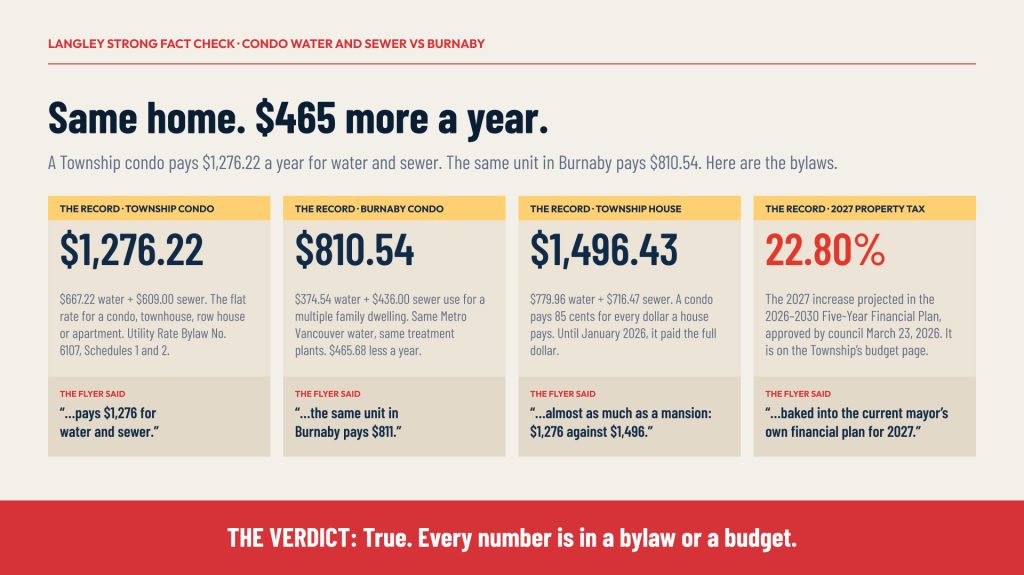
Yes. A Township condo or townhouse pays $1,276.22 a year. The same unit in Burnaby pays $810.54. And a Township condo pays 85% of what a detached house pays. Here are the bylaws.
The Claim
Langley Strong’s Willoughby flyer says: “Same home. $465 more a year.” It says a typical Township condo or townhouse pays $1,276 for water and sewer in 2026, that the same unit in Burnaby pays $811, and that a two-bedroom condo in the Township “still pays almost as much for water and sewer as a mansion: $1,276 against $1,496.” It also says a 22.8% tax hike is “baked into the current mayor’s own financial plan for 2027.”
Every one of those numbers come from a bylaw or a budget page published by the Township of Langley or the City of Burnaby. The links are below so you can check them yourself.
The Verdict
TRUE. The Township’s Utility Rate Bylaw No. 6107, as amended February 9, 2026, sets the 2026 flat charge for “a distinct Condo, Townhouse, Row House, or Apartment” at $667.22 for water and $609.00 for sewer: $1,276.22. The same bylaw sets a detached home at $779.96 and $716.47: $1,496.43. Burnaby’s 2026 residential utility fees set a “Multiple Family Dwelling” at $374.54 for water and $436.00 for sewer use: $810.54. The difference is $465.68. Both cities buy their water from Metro Vancouver and send their sewage to Metro Vancouver’s plants. Same pipes. The Township charges a condo $465 more.
Key Points
- Township condo or townhouse, 2026: $667.22 water + $609.00 sewer = $1,276.22. Utility Rate Bylaw No. 6107, Schedules 1 and 2.
- Township detached house, 2026: $779.96 water + $716.47 sewer = $1,496.43. Same bylaw. A condo pays 85 cents for every dollar a house pays.
- Burnaby condo or townhouse, 2026: $374.54 water + $436.00 sewer use = $810.54. City of Burnaby residential utility fees.
- Difference: $465.68 a year, for the same water from the same Metro Vancouver reservoirs.
- Until this year, a Township condo paid exactly what a house paid: $1,549.16. The January 2026 change cut the condo bill by $272.94 and still left it at 85% of a house. Langley Advance Times, January 27, 2026.
- Yes, Langley Strong councillors voted for the January 2026 cut. A $273 cut beat the 100% ratio it replaced. Kim Richter voted no because it did not go far enough. Council minutes, January 26, 2026, item G.4.
- Burnaby can hold rates down because it has about $1.9 billion in capital reserves. The Township drew $10.1 million from reserves this year just to meet its debt payments on the Woodward slate’s historic amounts of borrowing. Burnaby 2026–2030 Financial Plan · Township 2026 budget, documented September 27.
- The 22.8% figure is on the Township’s own budget page: the 2026–2030 Five-Year Financial Plan projects a 22.80% property tax increase for 2027. Township of Langley, Budget and Financial Plan 2026.
1. What a Township Condo Pays: $1,276.22
First, the basics. Most Township homes are not metered. Each home pays a flat annual charge for water and another for sewer, set by council in a bylaw, whether the home uses a little or a lot. Since 2025 those charges arrive on a separate utility statement, not on the property tax notice, which is why many people saw the number for the first time this spring.
The 2026 charges are in Utility Rate Bylaw No. 6107, amended by Bylaw No. 6193 on February 9, 2026. Schedule 1 (Water) sets the “Flat Annual Multi-Family Water Rate” at $667.22 and the “Flat Annual Water Rate” for a detached premise at $779.96. Schedule 2 (Sewer) sets the multi-family rate at $609.00 and the detached rate at $716.47. The multi-family rate applies to “a distinct Condo, Townhouse, Row House, or Apartment.” Add the two multi-family lines and you get $1,276.22. Add the two detached lines and you get $1,496.43. Those are the flyer’s two numbers, rounded to the dollar.
One year ago, there was no multi-family rate at all. In 2025 every home, condo or mansion, paid the same flat bill: $766.56 for water and $782.60 for sewer, $1,549.16 in total. Residents of condos and townhouses complained that they paid the same as a house while using far less. On January 26, 2026, council created the multi-family rate, cutting a condo’s water by $99.34 and sewer by $173.60. The Langley Advance Times reported it as “the first time residents on flat-rate utility payments have seen a difference based on the size of home they live in.” That is the change the mayor’s letters call “the largest reductions in utility costs ever.” It left a two-bedroom condo paying 85% of what a detached house pays. That is what the flyer means by “almost as much as a mansion.”
A fair question: did Langley Strong councillors vote for these rates? Yes. On January 26, 2026, item G.4, the 2026 rate bylaw carried with Councillors Kunst, Martens and Whitmarsh in favour and Councillor Richter opposed (video); the final reading on February 9 was unanimous. The choice on the table that day was a $273 cut for condo owners or no cut at all. Kunst, Martens and Whitmarsh took the cut. Richter voted no because 85% of a house is still too much. Nobody on Langley Strong has ever said the cut was the finish line. The mayor called it “one of the more substantial things we’ve done around affordability, ever.” We call it a start. The flyer is about what comes next: a bill that matches what a condo uses, and a gap to Burnaby that should not exist.
The vote that matters more is the one that created the problem. The mayor’s council split utility bills off the property tax notice in October 2024, under an agenda item labelled “Obsolete Policies,” with Richter the lone no vote. That is how thousands of condo owners found out in spring 2025 that they were paying $1,549.16, the same as a house. The “largest reduction ever” was a fix for a bill his own council had just put in front of them.
2. What a Burnaby Condo Pays: $810.54
Burnaby is the fair comparison because it is the same product. Both cities are members of Metro Vancouver. Both buy treated drinking water from the regional system and send their sewage to regional treatment plants. Neither runs its own reservoir. What differs is what each council adds on top and how it splits the bill between home types.
Burnaby’s 2026 residential utility fees list a “Multiple Family Dwelling” at $374.54 for water and $436.00 for sewer use: $810.54 a year, before Burnaby’s 5% discount for paying by the due date. The City held water flat in 2026 and raised sewer by 3.5%, about $14 a year for a condo, by drawing on reserves to absorb Metro Vancouver’s increases. The flyer rounds $810.54 to $811.
For completeness: Burnaby also charges a Sewer Parcel Tax on the property tax notice. For a multi-family building, the City charges that tax once per parcel and the units on the parcel share it; it was $293 per parcel in 2023. Spread across a building of condos, it comes to a few dollars a unit. It does not change the picture. Burnaby owners can see their full breakdown on the City’s fee page; the Burnaby Now explained how the parcel tax and use fees fit together.
The mayor may claim Burnaby keeps rates low by dipping into savings. True, and that is the point. Burnaby’s 2026–2030 Financial Plan puts its capital reserves at about $1.9 billion and says the City “can manage the increase from Metro Vancouver through the use of reserves.” A city that saved can shield its residents from a Metro Vancouver rate hike. The Township cannot. Its 2026 budget draws $10.1 million from reserves just to make the payments on debt that is headed past $64 million a year, and passes Metro’s increases straight through to the utility bill. Burnaby’s condo owners are living off decades of savings. The Township’s condo owners are paying for four years of borrowing. The $465 gap is the price of the difference.
3. The Gap: $465.68 a Year
$1,276.22 minus $810.54 is $465.68. A Township condo owner pays 57% more than a Burnaby condo owner for the same regional water and the same regional sewer treatment. Over a four-year council term, that is $1,862.72 out of one household.
The Township’s answer will be that its charges fund local pipes, reservoirs and pump stations. So do Burnaby’s. The question for a condo owner is why the Township’s version costs $465 more a year, and why, until ten months ago, the Township charged a 600-square-foot condo exactly what it charged a 6,000-square-foot house. Langley Strong’s platform commits to reviewing utility charges so people pay for what their homes use.
4. The 22.8%: It Is in His Own Plan
The flyer says a 22.8% tax hike is “baked into the current mayor’s own financial plan for 2027.” The Township’s own Budget and Financial Plan 2026 page lists the projected property tax increases in the 2026–2030 Five-Year Financial Plan, approved by council on March 23, 2026: 2027, 22.80%; 2028, 4.79%; 2029, 4.21%; 2030, 4.43%.
The Bottom Line
Every number on the flyer is a Township or Burnaby number. A Township condo pays $1,276.22 for water and sewer in 2026. A Burnaby condo pays $810.54. A Township house pays $1,496.43, so a condo pays 85% of a house. Until January, it paid 100%. Langley Strong councillors voted for that cut and say so; Burnaby shows how far there is still to go. The 22.8% is on the Township’s own budget page. The mayor’s letters call this “the largest reductions in utility costs ever.” Condo owners can read the bylaw and decide for themselves. Bad leaders mislead.
Sources
- Township of Langley, Utility Rate Bylaw No. 6107, as amended by Bylaw No. 6193 (February 9, 2026), Schedules 1 and 2
- City of Burnaby, Residential Utility Fees, 2026
- City of Burnaby, “Keeping utility rates down with City reserves,” January 13, 2026
- City of Burnaby, Council report on 2023 utility rates (sewer parcel tax and multi-family charges), November 21, 2022
- Burnaby Now, “Some Burnaby residents are paying 50% more for their utility fees. This is why”
- Township of Langley Council minutes, January 26, 2026, item G.4, 2026 Utility Budgets and Rate Bylaw · video
- Langley Advance Times, February 13, 2026: “Langley Township residents won’t have to pay utilities until July”
- Langley Monitor, April 13, 2025: “Eric Woodward’s Surprise Bill”
- City of Burnaby, 2026–2030 Financial Plan Highlights
- Langley Strong Fact Check, September 27, 2026 (2026 debt servicing and reserve draw)
- Langley Advance Times, January 27, 2026: “Water, sewer bills to drop for some Langley Township residents”
- Township of Langley, “Township separates billing of utility fees and property taxes,” February 27, 2025
- Township of Langley, Budget and Financial Plan 2026 (2026–2030 Five-Year Financial Plan projections)
- Langley Advance Times, February 26, 2026: “Contentious debate on Langley Township’s new budget”
- Langley Union, March 25, 2026: “Township Budget Approved, but the Math Is Getting Tight”
- Metro Vancouver, Water Services
- Langley Strong platform