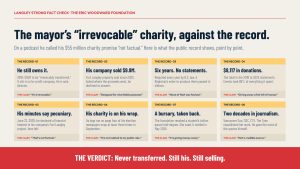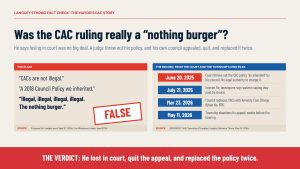

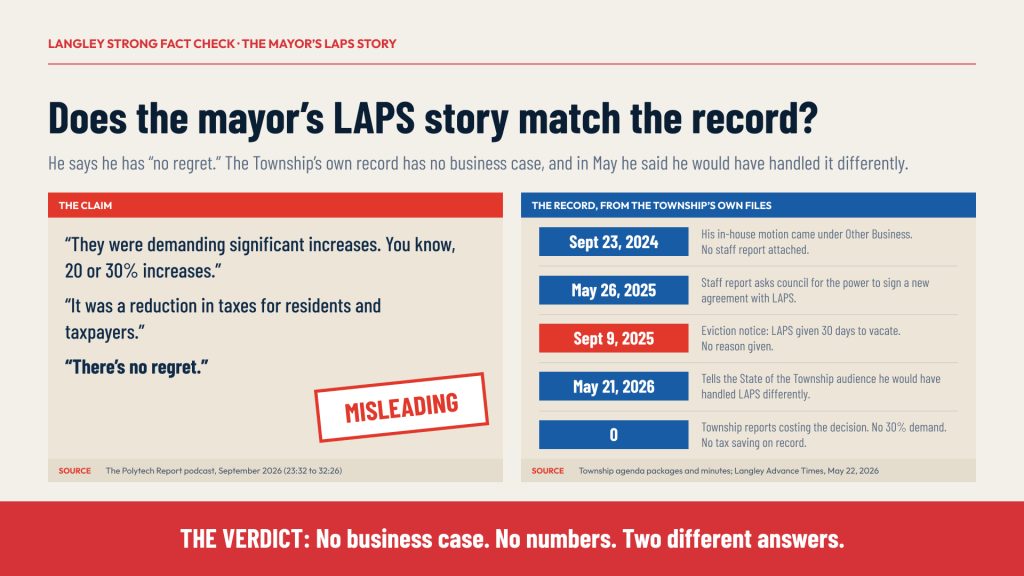
The claim: On the Polytech Report podcast this month, Eric Woodward gave his version of the 2025 fight with the Langley Animal Protection Society. He said the public reacted the way it did “given the information that they were given by LAPS, which wasn’t factual.” He said the shelter’s leaders “decided to gaslight the community directly and try to intimidate council into backing down.” He said “they were demanding, you know, significant increases. You know, 20 or 30% increases.” He said taking animal control in-house “was a reduction in taxes for residents and taxpayers while service quality went up.” And asked if he had regrets, he said: “there’s no regret.” (From 23:32 to 32:26 in the episode.)
The verdict: MISLEADING. The mayor gave one month’s notice to a 23-year partner caring for 800 animals, offered no reason, watched three protests fill Township Hall, then reversed and signed a 10-year deal with the same people. In May he told the State of the Township audience he would have handled LAPS differently. In September he says “no regret” and calls the shelter’s volunteers gaslighters. So we went and read the Township’s own record: both agenda packages and council minutes. There was no business case to fire LAPS. No staff report ever costed his preferred decision, and not one of the numbers he cites — the “20 or 30%,” the audit, the savings — appears anywhere in it. Neither does the termination itself: through the notice, the protests and the replacement agreement, LAPS is not mentioned once in the open record. The one thing on the record is his own conduct, and it does not match his story.
Key Points
- No business case to fire LAPS was ever provided.
- “No regret” in September. “Would have handled it differently” in May.
- The “reduction in taxes” has never been given a number.
- The “legal issues” he blames on LAPS were a warrant the Township was consulted on.
- In May 2025 the Township was writing LAPS into its future. In September it evicted them.
- Langley City looked at the facts and hired LAPS.
- The decision never reached an open council meeting.
- “We wish them well” and “they gaslit the community” don’t sync.
1. There is no business case. We read both agenda packages and ten sets of minutes.
On September 9, 2025, the Township handed LAPS a notice to vacate two facilities within 30 days. The shelter held more than 800 animals. LAPS said it had “no prior indication that the Township intended to wholly terminate its services” and that the Township “has not asserted that it is terminating LAPS’ services based on ‘just cause’ or for any alleged wrongdoing.” The Township’s own release two days later gave three phrases and no facts: “improved service delivery, strengthened accountability, and long-term cost savings.” When Global News asked for more, the Township declined, saying details would come “in the coming days.”
A year later, on a podcast, the mayor supplies his version of the details: LAPS was “demanding… 20 or 30% increases,” the Township “had no right to audit their spending,” service quality had slipped. So we went looking in the Township’s own record with LAPS.
The decision began at the September 23, 2024 council meeting, where the mayor moved to have staff prepare for animal control to be delivered by the Township’s own bylaw department. We pulled that meeting’s full agenda package. There is no staff report behind it. The item sits under “Other Business,” and it arrived with nothing attached: no business case, no costing, no service review, no comparison of LAPS against in-house delivery. A motion to defer was made by independent councillors, so council could take more time and get more information. It was defeated by the Woodward slate. The original motion then passed.
We then pulled the agenda package for the May 26, 2025 bylaw and read the staff report behind it in full — Report 25-82, Animal Control Bylaw Reform, from the Bylaw Enforcement Division. It is a dog-licensing modernization report. Its entire financial section is software: $12,000 a year for an online licence system, $7,500 a year for e-billing, and a licensing upgrade deferred to the 2026 budget. No LAPS contract value. No requested increase. No 30 per cent. No audit clause.
Then we read the minutes of every council meeting across the dispute. Nothing.
A 23-year partnership was ended by the mayor and his slate, and at no point did a single public document set out what it cost, what it would save, or what was wrong with the service. The mayor’s figures appear for the first time on a podcast, a year later, a month before an election. LAPS’s account is the opposite: council approved its 2022 budget increases “based on Township staff recommendations,” and staff meant to extend the agreement for five years with two five-year options. In 2022 the mayor’s own council praised LAPS’s work as “of the highest caliber.” If a document exists setting out a 30 per cent demand and a refused audit, the mayor should release it. He put the numbers in public; he can put the paper there too. Until he does, the only number residents have ever been given in this story is 30 – for 30 days notice for LAPS to get out of the shelter.
2. “No regret” in September. “Would have handled it differently” in May.
On May 21, 2026, at the State of the Township event at the Langley Events Centre, the mayor was asked what he would have done differently in four years. His answer, as reported by the Langley Advance Times: he would have changed how he dealt with LAPS in 2025.
Four months later, asked the same question on a podcast, he allowed that “with that experience… maybe I would have done it differently, but there’s no regret,” repeated “there’s no regret per se,” said LAPS was “probably one of the mistakes of the term,” and said LAPS “decided to gaslight the community,” “[tried] to intimidate council,” “trash[ed] you in the media and on their social media.” Both answers are his. In May, the mistake was how he dealt with LAPS. In September, on a podcast, he decided to swipe back at LAPS, its leaders, its volunteers and its supporters.
3. The “reduction in taxes” has never been given a number.
The mayor says the switch “was a reduction in taxes for residents and taxpayers while service quality went up.” The Township has never published what it paid LAPS for animal control, what it now costs to train and deploy bylaw officers as animal control officers, or the difference. The September 2025 release promises “long-term cost savings” with no figure. The December 2025 agreement announcement gives no cost information at all and says the animal control start date “will be announced.” On the podcast he claims there is “no reason why” Township bylaw officers “cannot also be certified animal control officers.” Training, vehicles, kennelling and after-hours coverage all cost money, and taking a bylaw officer off bylaw calls to chase a loose dog is not free either. A saving with no number is just spin.
4. The “legal issues” he blames on LAPS were a warrant the Township was consulted on.
The Township’s release said court proceedings showed “challenges associated with the third-party service delivery model” and a warrant problem “that resulted in a Charter breach.” That is the Enzo case. Here is what the court found. A Township-designated animal control officer, employed by LAPS, applied for the warrant “in consultation with the Township.” The judge found “technical issues with the information provided in the application” that made the warrant invalid, and also found that LAPS officers “acted reasonably,” used no excessive force, and that the dog’s injuries were self-inflicted. Under the Community Charter, the Township holds the legal authority over dangerous-dog enforcement. The Township shared the decision, then blamed the contractor for it.
5. In May 2025 the Township was writing LAPS into its future. In September the mayor evicted them.
If the shelter was failing residents, somebody forgot to tell the Township’s own staff.
Fifteen weeks before the mayor’s eviction notice, the Bylaw Enforcement Division brought council Report 25-82, Animal Control Bylaw Reform. It is a detailed rewrite of the Township’s animal rules, and LAPS is all over it — not as a problem to be solved, but as the expert being listened to.
The report says LAPS “over the years has provided recommendations for bylaw updates as well,” and that “these recommendations have been generally implemented into the new Animal Control Bylaw.” It credits LAPS by name for identifying that aggressive-dog designations could never be removed. It credits LAPS for raising the two-dog limit. On animal care provisions it says plainly: “In consultation with LAPS, staff recommend the inclusion of some limited animal care provisions.”
Then read recommendation 12. The new bylaw was written to “provide the Township CAO with the authority to enter into an agreement with LAPS to provide spaying and neutering (and temporary sheltering) of cats and dogs, exclusive to Township residents.”
On May 26, 2025, the Township of Langley asked its council for the legal power to sign a new agreement with the Langley Animal Protection Society. On September 9, 2025, it gave the Langley Animal Protection Society 30 days to vacate.
The same pattern runs through the September 23, 2024 motion that started all of this. Moved by Mayor Woodward, seconded by Councillor Rindt, it was expressly conditional on “a commitment to the Langley Animal Protection Society for it to continue to provide animal shelter services exclusive to Township of Langley residents and taxpayers.” Kunst, Martens and Richter voted against it; a motion to defer was defeated first.
Twice — in his own motion and in his staff’s report — the Township put on paper that LAPS would carry on. Then it turned into a registered letter of eviction/firing with no reason attached.
6. Langley City looked at the same facts and hired LAPS.
The mayor says LAPS could not compete with the Township’s “economies of scale.” Langley City, which shares the shelter, reached the opposite conclusion. In January 2026 the City signed with LAPS for animal control: two LAPS officers, $230,902 a year, plus $95,674 for dog sheltering, about 0.3 per cent on City taxes. Langley City’s mayor, Nathan Pachal, warned last spring that taking services in-house for his community “will drive up costs for both municipalities due to the reduction in volunteer and donor support.” LAPS raises about $350,000 a year in donations for cat care alone, money no bylaw department can replace. Mayor Woodward’s response to the City’s deal was to blame the City. “It is my opinion that City of Langley Council has put politics before animals,” he said, adding that “reducing the standard of care for animals, is entirely the doing of mayor and council in the City of Langley, absolutely not the Township of Langley.”
Read that beside what he had just done. While the City was signing on, the Township mayor and his slate tried to end the animal control contract. And the mayor who ended it accused the municipality that kept it of putting politics before animals. His negative responses to Langley City are always the same — see the RCMP split, the joint emergency program, and the amalgamation push.
7. The decision never reached an open council meeting.
The most striking thing in the Township’s record is what is missing from it.
Three steps toward bringing animal control in-house happened in the open. On September 23, 2024, the mayor moved to have staff prepare for it – a motion that, in its own words, was conditional on “a commitment to the Langley Animal Protection Society for it to continue to provide animal shelter services.” On May 26, 2025, council gave three readings to the new Animal Control Bylaw, on a staff report that asked for authority to sign a new agreement with LAPS. On June 9, 2025, council adopted that bylaw, moved by Councillor Rindt and seconded by the mayor, with Councillor Richter opposed.
Every one of those public steps kept LAPS in the picture. None of them terminated anything.
What was never public is the decision that actually happened: ending the LAPS agreement and giving the shelter 30 days to get out. We read the minutes of every regular council meeting the Township held in 2025 and the three 2024 meetings around the original motion. There is no motion to terminate the LAPS agreement. No report recommending it. No resolution authorizing the eviction. No delegation heard on it, and no closed-meeting resolution ever released about it. That holds through the September 15, 2025 meeting, six days after the notice and the same week 60 residents protested outside Township Hall, and all the way to December 15, 2025, the last meeting before the Township announced the new 10-year agreement – which also never came to an open meeting.
There are two places it could have happened out of sight. On June 23 and again on July 21, 2025, council resolved into closed session under section 90 of the Community Charter, and both times the grounds cited included subsection (k): “negotiations and related discussions respecting the proposed provision of a municipal service that are at their preliminary stages.” That is the provision a council uses to discuss changing who delivers a service. After July 21, council did not meet again in open session until September 15 — six days after the notice was served.
We are not going to assert what was said behind those doors, because the Township has not released it. It is also possible the termination was signed off by staff under existing authority, with no council vote at all — in which case the mayor can say so. Either way, residents are entitled to the question, and he is free to answer it: was the decision to evict LAPS taken in a closed meeting, and will he release the resolution? Or was it never voted on at all?
One of the largest controversies of the mayor’s term – a 23-year partnership ended, 800 animals in limbo, three protests, a petition, national coverage – was decided somewhere no resident could watch, speak to, or hold anyone accountable for. The public record shows council promising LAPS a future, then a registered letter ending it.
On the podcast the mayor says local government “is very transparent, very open,” that “you’re under such a microscope by the public,” and that “any larger decision is usually reviewed multiple times before it’s officially going.” On one of the biggest fights of his four years, residents got a press release with three adjectives and no numbers. Sadly this is typical of the way he operates.
8. “We wish them well” and “they gaslit the community” don’t sync.
Within one answer on the podcast, the mayor says LAPS management “decided to gaslight the community,” that “they went about it in a way that I think is quite regrettable.” Then it’s “we wish them well… it’s a great partnership.” He says LAPS was “the toughest one this term” and that “with the animal shelter, you don’t quite expect that.”
The people he is describing are the volunteers, donors and staff who run the Patti Dale shelter. They did not trash him; they stood up for what they believed in. They held three protests at Township Hall, the first with more than 60 people, and a petition that passed 1,994 signatures within days. The Langley Advance Times named LAPS supporters its 2025 Newsmaker of the Year. The mayor’s word for that is gaslighting. He then appointed a former LAPS executive director to the LAPS board as the Township’s representative, which is an odd thing to do with an organization he says cannot be trusted.
The bottom line: Thirty days’ notice. No reason given. Eight hundred animals. Three protests. A reversal, a 10-year deal, and a public admission in May that he would have done it differently. Now, with an election a month away, the story is that the shelter lied and he has no regrets. We checked both agenda packages and ten sets of minutes. His numbers are in none of them, and neither is a business case. Langley Strong will work with the Township’s partners, not against them, and will tell residents what things cost before declaring them a saving. Bad leaders mislead.