
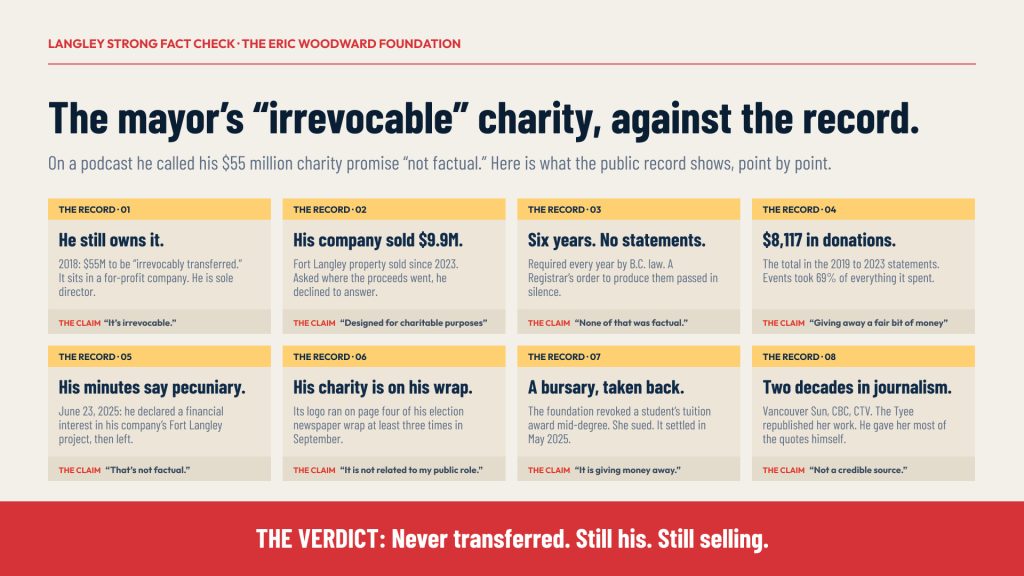
The claim: On the Polytech Report podcast, the host read guest Eric Woodward a listener’s question: that he promised in 2018 to place $55 million of Fort Langley real estate into a charitable trust to eliminate conflict-of-interest concerns, that investigative reporting has since shown the assets stayed in a private for-profit entity, that millions in property was sold, and that his foundation failed to open its books or file the financial disclosures the law requires. The mayor’s answer: “that’s not factual… None of that was factual.” He said he has “a nonprofit structure that is dedicated to giving away a fair bit of money,” that “it is inside a structure that is designed for charitable purposes. It’s irrevocable. It is giving money away.” He said the reporting came from “a so-called reporter from a private foundation,” that “it’s not a credible source,” “it wasn’t properly vetted,” and “they didn’t listen to the facts we gave them… they produce a hit piece.” (42:19 to 43:58 in the episode.)
The verdict: FALSE. Every element of the listener’s question is documented, most of it in the mayor’s own press release, his own filings and his own words. In 2018 he promised the property would be “irrevocably transferred” to the Eric Woodward Foundation. It never was. It sits in Fort Langley Properties Ltd., a for-profit company of which he is the sole director, which has sold $9.9 million of it since 2023 and is still bringing its Fort Langley projects to his council. The foundation prepared no financial statements for six years, ignored a provincial registrar’s order to produce them, and when they finally surfaced they showed just $8,117 in donations. And in June 2025, when his company’s Fort Langley project came before his own council, the Township’s minutes record him declaring a pecuniary – that is, financial – interest in it. You cannot have a financial interest in property you irrevocably gave to charity seven years earlier. And the charity he says is “not related to my public role” ran its logo on page four of his own election advertising wrap several times before the Oct. 17, 2026 election. The reporter he dismisses spent nearly two decades at the Vancouver Sun, CBC News and CTV News. He did not answer her questions.
Key Points
- “Irrevocable” describes a gift you have already made. He still owns it.
- The test of irrevocable is whether he can sell. He did: $9.9 million since 2023.
- Six years without financial statements, then a registrar’s order he ignored.
- The Foundation’s books, when they finally surfaced, showed $8,117 in donations.
- His own recusal proves the point: the Township’s minutes record a pecuniary interest.
- The charity “not related to my public role” is advertising on his election wrap.
- The foundation revoked a student’s bursary mid-degree. She sued. It settled.
- The “so-called reporter” ran in The Tyee. He gave her the quotes himself.
1. “Irrevocable” describes a gift you have already made. He still owns it.
On August 9, 2018, as he prepared to run for council, the mayor announced that his Fort Langley holdings, then worth $55 million, would be “irrevocably transferred to the newly-formed Eric Woodward Foundation beginning in 2019,” starting with $18 million in property and growing past $100 million in 10 to 15 years. “The development profit and rental income from any future development will go to registered charities,” he said. “This plan will happen either way, run or not run, win or lose.”
The transfer never happened. In September 2025 the Investigative Journalism Foundation reported that none of the real estate went to the Eric Woodward Foundation, and that the foundation was never registered as a charity. The Tyee, reporting separately, found the property held by Fort Langley Properties, a for-profit corporation with Woodward as sole director. His explanation: “non-profit entities are not permitted to conduct purely for-profit activities, such as real estate development.”
The Tyee put the contradiction in one sentence: “Instead of being ‘irrevocably transferred’ to the EWF as the press release promised, Woodward’s real estate holdings are now owned by a new, for-profit company called Fort Langley Properties.”
That may well be a real legal problem. It is also not what he told voters, and it is why “irrevocable” does no work here. Irrevocable is a word about a gift already made: it means the giver cannot take it back. Nothing was given. The $55 million in real estate is not inside the structure he is describing. He owns it, he develops it, he sells it, and he decides if and when any of the proceeds become charity. Whatever is irrevocable inside that nonprofit, the land isn’t.
2. The test of irrevocable is whether he can sell. He did: $9.9 million since 2023.
A for-profit company with a single director does what that director decides. Since 2023, Fort Langley Properties has sold property totalling $9.9 million, according to assessment records. Asked how the proceeds were used and whether any went to charity, the mayor declined to answer.
Former Township councillor Angie Quaale, who reviewed the financial statements, put it like this: “He’s still filing for development permits and making lots of money off these properties… where’s all the money?”
3. Six years without financial statements, then a registrar’s order he ignored.
Every B.C. society must prepare financial statements every year. It is the law. The Eric Woodward Foundation, incorporated in 2019, prepared none for six years.
When the IJF requested them, neither the mayor nor the other directors responded, and the Vancouver tax law firm that serves as the foundation’s registered office said it had never received any. On July 31, 2025, the B.C. Registrar of Companies ordered the foundation to produce the statements within 10 days. The deadline passed in silence.
His explanations, in his own words, to The Tyee: “You can’t provide financials that aren’t prepared yet. So, though there was a couple of years’ delay, we’re preparing them and they’ve been finalized, I believe, to year-end, 2023.” On the six years of silence before that: “I haven’t had as much time to devote to it, but it’s still underway and we’ve still got big plans for the future.”
Asked for details of the foundation’s charitable giving: “I mean, I could, but why would I?” Asked about scholarship payments: “I’m gonna ask again, why would I do that?” Asked about the foundation and his office: “It is not related to my public role.” It was related enough in 2018 to announce it alongside his first campaign.
And asked why anyone would want to see the books at all, he said this: “The only people that I’ve known to have this level of interest in the foundation are people that have an ulterior motive.”
That is the answer Langley residents get for asking if he is telling the truth about where $55 million went.
The statements reached the registrar on November 18, 2025, with a declaration signed by the mayor that the 2024 financials were still incomplete. A second society he founded in 2022, the Fort Langley Project Society, described by him as the umbrella over the foundation and his company, is “being prepared to be dissolved.” It never operated and never had a bank account.
4. The books, when they finally surfaced, showed $8,117 in donations.
The 2019 to 2023 statements list “donations” as an expense exactly once, in 2023: $8,117. The foundation’s only revenue over five years was $463,000 in “sales,” mostly the Fort Langley Night Market. Events consumed $325,000, about 69 per cent of everything it spent. The statements carry liabilities of $20,000 to $40,000 a year described only as “due to director,” including in 2020, a year with no event expenses at all. Vancouver non-profit lawyer Martha Rans, founder of Law for Non-Profits, called the statements “curious,” and noted that B.C. regulations require a note explaining any payment to a director. On what a foundation is for, she told The Tyee: “The primary purpose of a foundation is to raise money for the benefit of the community.” On this one: “It’s difficult to see what this foundation is doing because there’s not much on their website.” And on the distance between the 2018 announcement and what followed: “But what is it they say about the road that’s paved with good intentions?”
Former Township councillor Angie Quaale, who has sat on non-profit boards herself, asked the residents’ version of the question: “What is going on? Where is all this money going? Where is the money from the cranberry festival?”
The mayor’s answer, given on Reddit rather than to the reporter, is that the donations announced between 2018 and 2021 came from Fort Langley Properties, his for-profit company, “because that’s the entity that can use the charitable tax receipt.”
So his giving runs through a private company he alone controls, claiming the tax receipt itself, on a schedule and at a scale only he can see. The structure voters were promised – one that would hold the land whatever he decided later – was never built.
5. His own recusal proves the point: the Township’s minutes record a pecuniary interest.
The 2018 announcement acknowledged the foundation would “address potential conflict of interest charges if he runs.” That was the deal offered to voters: the largest commercial landowner in Fort Langley could sit on council, and later chair it, because the property would no longer be his.
It is still his, and went in front of his council. The minutes of the June 23, 2025 council meeting record it as item G.2, rezoning application 100786, Zoning Bylaw Amendment (Fort Langley Properties Ltd.) Bylaw No. 6134 — the Glover Road, Mary Avenue and Church Street site in the Fort Langley Heritage Conservation Area. The application converted second-floor office space to housing, taking the project from 47 to 76 residential units in two three-storey buildings.
The mayor followed the rule on the day. The minutes record it precisely: “Mayor Woodward declared a Conflict of Interest under Section 100 of the Community Charter due to a pecuniary interest and left the meeting at 2:12pm.”
Read that sentence again, because it settles the argument.
Pecuniary means money. Section 100 of the Community Charter requires a council member to step out where they have a direct or indirect financial interest in the matter before them. In June 2025 the Township’s own minutes record the mayor declaring exactly that in his company’s Fort Langley development.
You do not have a pecuniary interest in property you gave away seven years ago. If the 2018 promise had been kept – if the Fort Langley holdings had been “irrevocably transferred” to a charitable foundation – the profits from that project would belong to charity, and the mayor’s interest would be a charitable one, not a financial one. The Township’s minutes say it is financial. The recusal he offers as proof of his integrity is, in the same breath, the clearest official confirmation that the transfer never happened and that he still stands to make money from Fort Langley land.
He cannot have it both ways. Either the property is irrevocably committed to charity, as he told voters in 2018 and repeated on a podcast this month, or he has a pecuniary interest in it, as his own council’s minutes record. It cannot be both.
What happened after he left the room is also worth reading. The motion was moved by Councillor Ferguson and seconded by Councillor Rindt. First, second and third reading were given in a single sitting. It carried, with Councillors Kunst, Martens and Richter opposed. Passed by Woodward’s own slate candidates, for whom he is also the campaign financial agent.
There was no public hearing. Residents could email written comments to the Township by noon on the day of the meeting, and that was the whole of their say. “There are no speaking opportunities,” residents were told. Township administrator Chan Kooner, who on the same podcast was touted by Woodward as “aligned” and “friendly to my agenda”, advised that public-hearing-style input carried legal risk under provincial legislation meant to speed housing approvals: “Public input opportunities that are public-hearing style, there could be a risk with that.”
It had happened before. When an earlier version came to council in June 2023, the Heritage Advisory Committee recommended a public input opportunity and council voted against it.
Recusal is the bare legal minimum, and he met it. But recusal does not answer the question the foundation was supposed to answer. A mayor’s company brought a bigger building to his own council, in Langley’s most protected heritage area, and his own slate passed it without letting a single resident speak. In 2018 he said a charitable transfer would take this problem off the table. Eight years on, the property is his, the profit is his, and the votes are his slate’s.
6. The charity “not related to my public role” is advertising on his election newspaper wrap.
Asked by The Tyee about the foundation and his job as mayor, the mayor said: “It is not related to my public role.”
At least three times in September, 2026 – leading up to the election – the Langley Advance Times went out to Langley households inside a four-page advertising wrap. Three pages promote Woodward’s campaign.
The fourth page: an ad for the Fort Langley Cranberry Festival. Along the bottom, sponsor logos. One is Ocean Spray. The other is the Eric Woodward Foundation.
Three pages of campaign, one page of charity, three wraps, three newspapers.
The foundation is not incidental to this story. It is the entity he created in 2018 to answer the conflict-of-interest question, the entity that filed no statements for six years, the entity that reported just $8,117 in donations, and the entity he says has nothing to do with his public role. And the Cranberry Festival is the very event former councillor Angie Quaale was asking about when she said: “Where is the money from the cranberry festival?”
It is also the event he has given shifting accounts of. He told the IJF the festivals had been “transitioned off” to a local consultant when he became mayor, and that “those do not run through our bank accounts.” He later told Reddit that the foundation’s “revenues and expenses were mostly for the Fort Langley Night Market held up to 2024.” The foundation’s own statements show events consumed 69 per cent of everything it spent.
We are not alleging that charitable money paid for campaign advertising. What is in front of residents is simpler and does not need alleging: the mayor’s re-election advertising and his charity’s branding arrived on the same four sheets of newsprint, just before they vote.
There is a fair question, and it has a paper answer the mayor can produce whenever he likes: who paid for the fourth page? If the campaign bought the full wrap, the charity’s logo ran inside advertising the campaign paid for. If the festival or the foundation bought that page, then charity-adjacent money bought space inside the mayor’s election wrap. One of those is true.
In 2018 he promised a structure that would put distance between his money and his office. Eight years on, his charity’s logo is riding on his campaign’s advertising wrap.
7. The foundation revoked a student’s bursary mid-degree. She sued. It settled.
In April 2022 the Eric Woodward Foundation awarded one of six bursaries to a Langley student, covering, in the foundation’s words, “the full cost of tuition for up to four consecutive years, or until a first bachelor’s degree or diploma is achieved.” In April 2024, partway through her degree, the foundation revoked it.
She filed in small claims court in August 2024, arguing the award was effectively a four-year commitment and that the revocation left roughly $13,500 in tuition unpaid. The foundation’s defence was that it had never promised the full term and could end the bursary without cause. The case settled in late May 2025 on confidential terms.
The mayor’s own account of it: “it was unfortunate that we felt we had to move forward with that revocation,” and, on the settlement, “It’s hard for me to discuss that now, since the matter has settled.”
This is the charity he points to when the conflict question is raised. Its most public act toward an individual student was to take back an award it had already made, and to argue in court that it was entitled to do so without cause.
8. Two investigations, one republished by The Tyee. He gave the reporter the quotes himself.
The mayor told the podcast the story came from “a so-called reporter from a private foundation,” that it was “not a credible source,” “wasn’t properly vetted,” and that “we submitted a whole bunch of information to them. They ignored it.”
The reporter is Bethany Lindsay, a senior investigative reporter covering white-collar crime, with nearly two decades in journalism at the Vancouver Sun, CBC News, CTV News and the North Shore News, and an RTDNA data journalism award for her work on B.C.’s civil forfeiture regime.
There are two stories, a year in the making, and it is worth being precise about where they ran.
The first was written for the Investigative Journalism Foundation, in September 2025, reported that the property was never transferred and that the mayor had ignored the registrar’s order. The Tyee republished it under its own masthead on September 22 — “Langley Township Mayor’s Promise to Open a Charity Is Shrouded in Secrecy” — with the credit line: “This story was originally published by the Investigative Journalism Foundation.”
That republication matters. The mayor’s complaint is that the work “wasn’t properly vetted.” The Tyee is an established B.C. news outlet with its own editors, and it put this reporting in front of its readers under its own name. Editors free to pass on it decided it was solid.
The second, in December 2025, reported what the financial statements showed once they finally surfaced. It ran on Castanet and in the Penticton Herald.
And he did talk to her — at length. Nearly every Woodward quote in this fact check is an answer he gave her for the September story. What changed in December, once the books were out, is that he stopped answering: the IJF says he “did not respond to an interview request or an emailed list of questions.” He posted on Reddit instead, contradicted his own earlier account of the night markets, and did not respond when asked about the contradiction.
So “they didn’t listen to the facts we gave them” describes a story he declined to speak to.
The pattern is familiar. Reporters who check his numbers are “short on facts,” “easily manipulated,” bound to “get it wrong. Again.” Now they are “so-called.”
The bottom line: The Langley resident’s question was accurate in every particular, and the mayor called it “not factual.” He promised in 2018 to irrevocably transfer $55 million to a charitable foundation and to settle the conflict question for good. Nothing was transferred. $9.9 million has been sold. The foundation filed nothing for six years, ignored a provincial order, and reported $8,117 in donations. It revoked a student’s bursary mid-degree and settled her lawsuit. And when his company’s Fort Langley project cleared his own council this term in a single sitting, with no one allowed to speak, the minutes recorded his interest in it as pecuniary – financial. That is the whole answer to “it’s irrevocable.” And in September 2026 the charity he calls unrelated to his public role appeared as a sponsor logo inside his own re-election wrap. This is not about the mayor’s private life. It is about a public promise, made to win public office, that was never kept – and a mayor whose answer, when shown the record, is to attack the person holding it. Langley Strong will answer questions about money with documents. Bad leaders mislead.