
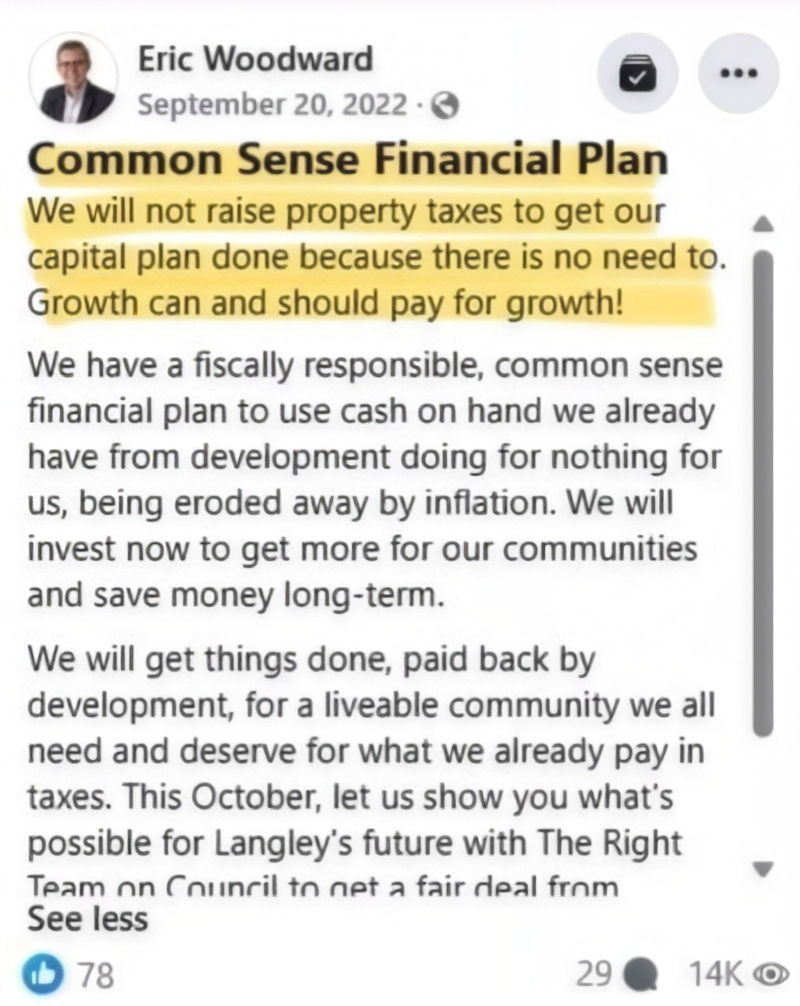
The claim: In a September 3 carousel, Progress for Langley says the Township “has 3 choices” on growth and that the slate “chooses Option 1”: build the roads, parks and rec centres a growing town needs and “use the funding generated alongside growth to help pay for it.” The tools it lists: “DCCs. ACCs. CACs. Grants. Reserves. Other available funding.” The tagline: Growth Pays for Growth. In the comments, candidate Tess Rouse adds that the Township “remains second lowest in Metro Vancouver for combined municipal property taxes and utilities, approximately $1,200 below the regional average.”
The verdict: MISLEADING. “Growth pays for growth” is sound in theory. Every city uses development charges to help fund the pipes and parks new homes need. The problem is not the idea. It is what this mayor and slate have done with it. He has run the Township on this slogan for four years. In that time, growth slowed, home building fell, a court threw out one of the three fees on his list, property taxes still rose 22 per cent, and his own five-year plan pencils in another 22.8 per cent for next year. The people paying the growth charges are not developers. They are the young families buying their first Langley townhouse. And the day they move in, they become the “existing residents” the slate claims it is protecting.
Key Points
- Growth is slowing, and the mayor says so himself.
- Home building is falling faster still.
- One of the three fees on the slide no longer exists. A judge struck it down.
- Growth charges are pass-through costs. Developers collect them. Home buyers pay them.
- Under “growth pays for growth,” taxes went up 22 per cent anyway.
- The mayor’s own financial plan says what happens when growth money runs out: a 22.8 per cent hike in one year.
- Condo and townhouse owners already pay $990 more in taxes than they would in Burnaby.
- The mayor’s whole pitch depends on dividing Langley into two camps.
1. Growth is slowing, and the mayor says so himself.
The mayor and slate’s carousel opens with “Here’s what we know: Langley is growing.” True. But the pace has dropped, and the mayor told council so in February. The Township’s own numbers put population growth at 3.16 per cent in 2021 and 3.35 per cent in 2022, then 2.36, 2.31 and 2.41 per cent in the three years since. The mayor’s report to council called that a drop of “roughly 30 per cent” since 2023. School enrolment tells the same story: more than 1,000 new students a year in 2021 to 2023, then 860, then 641.
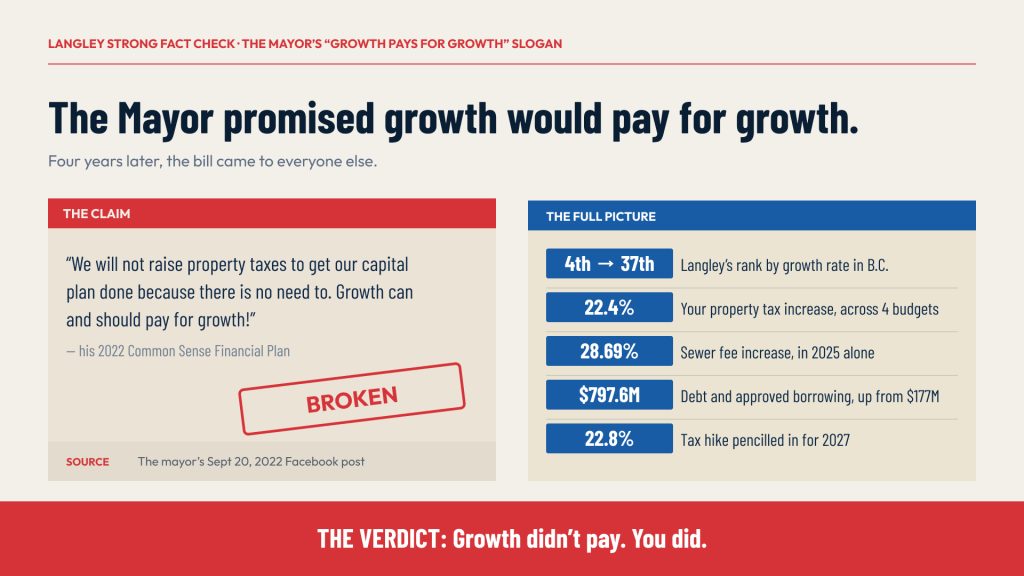
The provincial comparisons are starker. By BC Stats’ municipal estimates, the Township grew 5.2 per cent in 2022-23, the mayor’s first year in office, and ranked fourth of B.C.’s 165 municipalities. Among cities of 10,000 or more, only Surrey grew faster. In 2024-25 it grew 1.3 per cent and ranked 37th overall, 15th among the larger cities. Abbotsford grew 2.0 per cent, Surrey 1.9, Chilliwack 1.8 and Mission 1.6 in the same year. BC Stats projects the Township at 0.9 per cent for 2025-26, another decline. A campaign built on “growth pays for growth” is betting on a growth rate its own leader says has fallen by nearly a third, and that the province says has fallen by three-quarters. The mayor says the slowdown was deliberate, a 2023 decision to phase Willoughby. Fine. Then borrowing hundreds of millions on the assumption growth revenue would keep flowing was not a smart plan. He did both.
2. Home building is falling faster still.
If growth is going to pay for anything, someone has to build the homes. They are not. The Township approved 2,121 housing units in 2025, down 14.9 per cent from 2,493 in 2024, with single-family permits at a five-year low. The first seven months of 2026 were worse: 1,357 units against 1,941 a year earlier, a 30 per cent drop, and total construction value down from $740 million to $471 million. Langley Strong councillor Margaret Kunst said it plainly at the council table in February: “We’re not seeing a ton of development here in the Township, we don’t see a lot coming across the table like we did in the past.”
It is not just Langley. The Independent Contractors and Businesses Association forecasts B.C. housing starts falling from 42,200 in 2025 to 34,500 in 2026, an 18 per cent drop, after peaking at 50,500 in 2023. CMHC’s deputy chief economist blames “rising uncertainty, higher development costs, weaker demand and more unsold homes.” Note the second item on that list: “Higher development costs” is what the mayor did to DCCs in 2024. The Township’s growth-funded budget rests on a revenue stream that is shrinking – in part due to its own actions.
3. One of the three fees on the slide no longer exists. A judge struck it down.
The slide lists “DCCs. ACCs. CACs.” as the tools that make growth pay. On June 20, 2025, the B.C. Supreme Court threw out the Township’s Community Amenity Contribution (CAC) policy. In Lorval Developments Ltd. v. Langley (Township), 2025 BCSC 1148, Justice Simon Coval found the policy was not the “voluntary” scheme the Township claimed but a mandatory payment regime the Township had no legal authority to impose. The mayor called the ruling a “nothingburger.” The Township appealed anyway, then dropped the appeal in June 2026 without ever getting a higher court to look at it. Fifteen months after a judge said the Township was collecting money it had no right to collect, the slate is still putting CACs on its slides as a funding source.
4. Growth charges are pass-through costs. Developers collect them. Home buyers pay them.
The slogan works because voters picture a developer (like the mayor himself) writing the cheque. That is not how it works. A development charge is a pass-through cost, the same as the GST on the sale. The builder adds it to the price of the home, and the family who buys the home pays it, with interest, over 25 years of mortgage payments.
Look at the size of it. In January 2024 the mayor’s council raised Development Cost Charges by 46 to 81 per cent depending on the home type, trimmed only after the provincial Inspector of Municipalities made it drop a Highway 1 project from the roads charge. Today the Township DCC alone is $38,482 on an apartment, $55,268 on a townhouse and $86,787 on a single-family lot. On top of that, the new Amenity Cost Charge adds $8,634 per apartment, $13,584 per townhouse and $19,571 per house. That is roughly $69,000 in Township charges on a new townhouse before Metro Vancouver, TransLink and school-site charges are counted. Every dollar of it lands on a real person: a nurse, an apprentice, a young couple leaving their parents’ basement suite.
Council has never repealed that hike. It has re-adopted the same bylaw twice, in December 2024 and November 2025, each time restarting a one-year grace period so projects already in the queue keep paying the old rates, now until November 2026. Two years of quietly delaying his own policy is not a plan. A council that keeps postponing its own fee is telling you what it thinks of it.
When the price will not bear it, the developer does not absorb the charge. The project stops. That is what the permit numbers above show, and the industry said so at the time: a fee hike of this size means a project “is put on hold until it returns to profitability, which usually requires an increase in home selling prices.” The Township knows it too. Its own DCC page now floats cuts of 17 per cent and more to the residential rates. If growth charges were paying for growth with no side effects, the Township would not be proposing to cut them in an election year.
5. Under “growth pays for growth,” taxes went up 22 per cent anyway.
The slate’s “Option 3” is the scary one: “existing residents paying more through property taxes.” That is not a hypothetical. It is this mayor and slate’s record. Over their four budgets, Township property taxes rose 5.37 per cent (2023), 6.88 per cent (2024), 4.50 per cent (2025) and 3.97 per cent (2026). Compounded, that is 22.4 per cent in four years, above inflation every year. Utility fees rose faster: in 2025 alone, sewer went up 28.69 per cent, solid waste 12.56 per cent and water 8.71 per cent. Residents got Option 1 and Option 3 at the same time.
6. The mayor’s own plan says what happens when growth money runs out.
The 2026 five-year financial plan projects a 22.8 per cent property tax increase in 2027. The jump, the Township says, reflects major project costs “currently supported through reserves and development revenue.” In plain terms: his major projects were built on borrowed money. The payments on that debt are being made today from reserves (your money, already paid) and development revenue (the home buyer charges above). Growth was supposed to keep both topped up. It isn’t. The mayor’s standing answer is that “those revenues pay for it.” His own budget says they are not. When that money thins out, the debt does not shrink. The payments simply move to your property tax bill. That is the 22.8 per cent.
The mayor’s answer at the budget table was that the projection “has never come to fruition.” Last year’s projection for 2026 was over 17 per cent; the real number was under 4. The gap did not vanish. It went on the credit card. When the mayor took office, the Township owed $177 million. Its audited debt was $584 million at the end of 2025. Add the borrowing his slate has already approved by 5–4 vote and the total is $797 million, with debt servicing set to climb from $47 million this year to $64.2 million by 2030.
There is another hole in the slogan. Most of the growth the mayor talks about has already happened. Due in large part to the Justin Trudeau-era immigration spike, the Township added more than 15,000 people between 2021 and 2025, most of it before his 2024 fee hikes took effect and much of it under permits grandfathered at the old rates. He cannot go back and levy new charges on homes that are already built and sold. The infrastructure those homes need still has to be paid for, and the only tool left for that is the one the slate calls “Option 3”: tax everyone more. That is what their plan’s 22.8 per cent hike in 2027 is.
7. Condo and townhouse owners already pay $990 more than they would in Burnaby.
Rouse’s comment repeats the “second lowest” tax cherry-pick, which we debunked last week. Short version: it ranks the bill on one detached house, and that house is cheaper than the ones it is measured against. Nearly 60 per cent of Township households live in a condo, townhouse or suite, and for them the Township is sixth-highest of 15 in the region at $3,029.63 in municipal tax and utilities, against $2,039.69 in Burnaby. That is $990 a year, every year. Those are the homes growth charges were supposed to make affordable. Under this mayor’s model, they cost more to buy and more to own.
8. The whole pitch depends on dividing Langley into two camps.
Strip the graphics away and the slate’s argument is this: there are “existing residents,” and there is “growth,” and we will make the second group pay so the first group does not have to. It is a deliberate wedge. It invites the family that has lived in Brookswood for 30 years to resent the family moving into Willoughby next month as a cost to be recovered rather than a neighbour to be welcomed. And it only works if you forget that the two groups are the same people.
The couple who paid $69,000 in growth charges on a townhouse is a Langley taxpayer the day they get the keys. They pay the same 22 per cent in tax hikes. They pay the same 28.69 per cent sewer increase. Their kids sit in the same portables. When does the slate stop calling them “growth”? After five years? Ten? Twenty? The slate never says, because the answer is never. They are simply the neighbours who got charged twice: once at the sales centre, again every July. A mayor who needs one half of the community to resent the other half to sell his budget does not have a plan. He has a wedge.
“Growth pays for growth” is a sound idea, and every council in B.C. uses some version of it. The mayor’s version has had four years and a Township credit card to prove itself. Growth slowed. Building stalled. A court struck down a large piece of it. Taxes still rose 22 per cent, and the next budget has a 22.8 per cent hike written into it. The theory was fine. His execution of it has been an expensive four-year, failed experiment, and all Township residents, old and new, are the ones paying for it. Langley Strong will finish what families were promised, in the open, with a plan that adds up.