
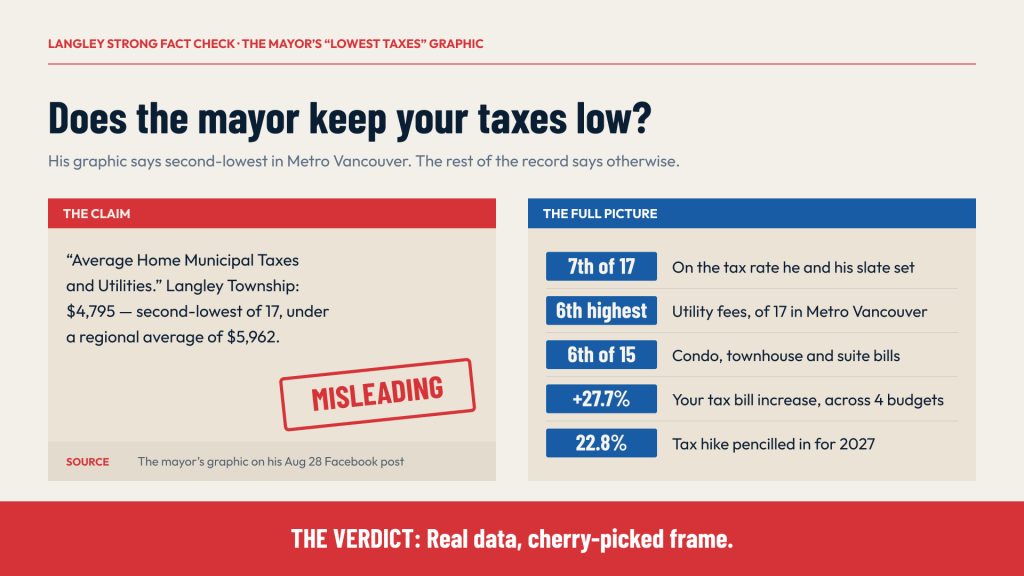
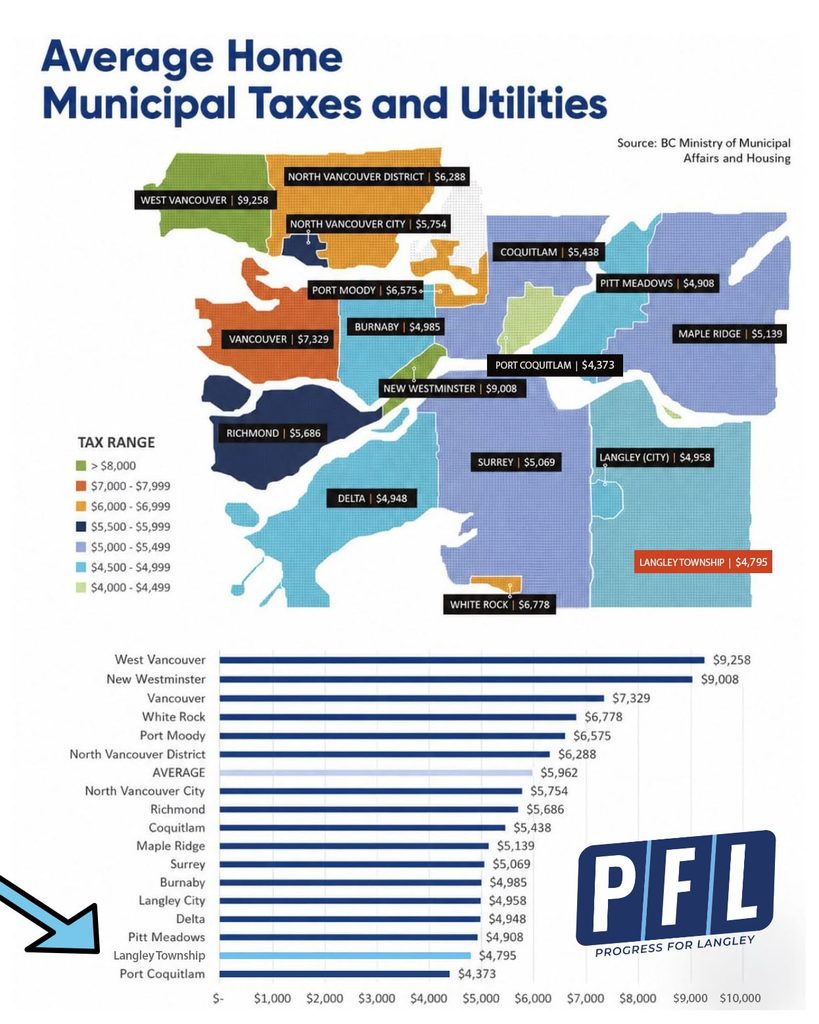
The claim: The mayor and his slate are circulating a graphic titled “Average Home Municipal Taxes and Utilities,” credited to the BC Ministry of Municipal Affairs. It ranks 17 Metro Vancouver municipalities and puts Langley Township at $4,795, second-lowest, under a regional “average” of $5,962. The message: the mayor keeps your taxes low.
The verdict: MISLEADING. The numbers come from the Province’s 2025 Schedule 704, and they add up. What the mayor did with them is the problem. He picked the one measure that flatters him: the dollar bill on one detached house, in the year before an election. Measure the tax rate, the utility fees, the condo and townhouse bill, the four-year trend, or the debt holding the bill down, and the Township is mid-pack at best and near the bottom of the region on several. Real data, cherry-picked frame.
Key Points
1. It is a house-price ranking, not a tax ranking.
The bill on the Province’s “representative house” is the tax rate times the house value. The Township’s assessed house was worth $1,511,423 in 2025. Burnaby’s was $2,157,640, Vancouver’s $2,678,306, West Vancouver’s $3,676,139. Cheaper houses make smaller bills. Look at the tax rate the mayor and his slate set and the Township drops from second-lowest to seventh of 17, at $1.8758 per $1,000. Burnaby, Surrey, North Vancouver District, West Vancouver, Richmond and Vancouver all tax a dollar of assessed value more lightly. A Township house assessed at Burnaby’s average would pay about $4,047 in municipal tax, not $2,835. Count fees too, per dollar of value, and the Township is tenth of 17: the wrong half of the table.
2. The fee line is one of the highest in the region.
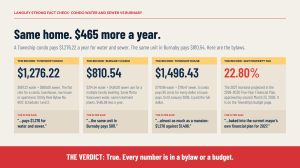
The graphic’s $4,795 includes $1,960 in flat water, sewer and garbage fees. That is sixth-highest of the 17: above Surrey ($1,650), Delta ($1,607), Maple Ridge ($1,503), Port Coquitlam ($1,369) and Burnaby ($888). The 2025 budget raised sewer fees 28.69 per cent, water 8.71 per cent and solid waste 12.56 per cent, and in the same year the Township mailed those fees on a separate statement for the first time. Residents were blindsided; the mayor conceded the notice “should have been sent at the same time as the property tax statement”, but he didn’t fix it for 2026. This year, $1,922 of the Township’s $4,872 take from the average house, 39 cents of every dollar, now arrives on a utility bill he tries not to call tax. Fees are up 33.9 per cent since 2022; the tax line is up 24 per cent.
3. It counts detached houses only, and most Township households do not live in one.
The 2021 census found 47.6 per cent of the Township’s 46,925 homes were single-detached houses. Everything built since has pushed that even lower. The Township’s own building statistics show 6,132 multi-family units approved from 2022 to 2025 against 1,491 single-family homes: four out of five new homes were condos or townhouses (2022–2023, 2024–2025). In the first seven months of 2026 it was 1,168 multi-family to 103 single-family, better than nine in ten. Add the 1,370 secondary suites approved over the same span and our estimate is that close to six in ten Township households now live in a condo, townhouse or suite. The graphic has nothing to say to any of them.
4. For those condo and townhome households, the Township is one of the most expensive places in Metro Vancouver.
Langley City staff run the same provincial comparison for apartments and townhouses every year. Their 2025 table put the Township sixth-highest of 15 for strata homes, at $3,029.63 in municipal tax and utilities. Surrey was $2,582.94, Port Coquitlam $2,497.06, Delta $2,385.76, Burnaby $2,039.69. A Langley Township condo paid $447 more than one in Surrey and $990 more than one in Burnaby. The reason is the mayor’s flat fee: a one-bedroom condo was charged the same $1,549.16 for water and sewer as a five-bedroom house, the second-highest strata utility charge in the region. After residents complained, council cut multi-family water and sewer by $272.94 for 2026. That is an admission, not a fix: a Township condo still pays $1,276.22 for water and sewer alone, more than Surrey charges a condo for everything.
5. Four budgets, four above-inflation tax hikes.
The mayor’s council approved increases of 5.37 per cent (2023), 6.88 per cent (2024), 4.50 per cent (2025) and 3.97 per cent (2026). Compounded, that is 22.4 per cent in four years. Take the same three lines the graphic uses and run them from the 2022 file to the 2026 file: $3,814 to $4,872, up 27.7 per cent. Port Coquitlam held its rise to 21.2 per cent and West Vancouver to 22.3 per cent. “Among the lowest” describes where the bill sat when the mayor arrived, not what he has done to it since.
6. Even the “average” is cherry-picked.
The $5,962 is a simple mean, dragged up by West Vancouver ($9,258) and New Westminster ($9,008), whose fees include electricity because it runs its own power utility. The median of the 17 is $5,438. The Township is still under it, by $643, not the $1,167 the graphic implies.
7. The “low” bill is on the credit card.
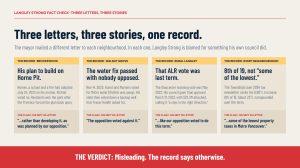
When the mayor took office, the Township owed $177 million. Its own audited statements put debt and agreements payable at $584 million on December 31, 2025. Counting borrowing in progress and approved, the Township’s own 2026 capital budget puts the total at nearly $800 million: $420.3 million in place, $182.4 million in progress (including $39.3 million for Smith Athletic Park Phase 2 and $5.8 million for the 212 Street connector), $17.6 million approved for the Willoughby Community Centre and Library, and $177.3 million through the mayor’s Housing Trust Society, debt the Township first said would not touch its borrowing limit and then quietly conceded, in the same plan, that it does. Total: $797.6 million. The same deck puts the Township’s remaining annual debt-servicing room at an estimated $11 million. Even on the Township’s books alone, CBC reported in April that the Township has the highest debt per person of any major city in the province. Debt servicing is $53 million this year and the mayor’s own plan takes it to $74 million by 2030. His answer to his own number: “I can assure you, if I’m still sitting here that will not be the case.” The plan pays for that debt with development revenue, and development is slowing: 2,498 new units approved in 2022, 2,121 in 2025, 1,357 through July 2026. Councillor Margaret Kunst said it at the budget table: “We’re not seeing a ton of development here in the Township.” When developers stop paying, taxpayers are the backstop.
8. The mayor’s own plan pencils in a 22.8 per cent tax hike for 2027.
The five-year financial plan adopted with the 2026 budget projects a 22.8 per cent tax increase the year after the election. This is his plan, it is in his budget, and it is there because his spending outruns his revenue.
The bottom line: The graphic is about one number, for one kind of home, in one year. On the tax rate the Township is seventh of 17. On utility fees it is sixth-highest. For the six in ten households in a condo, townhouse or suite it was sixth-highest in the region in 2025, and a Township condo paid $990 more than a Burnaby one. The bill is up 27.7 per cent in four years, propped up by close to $800 million in debt, the biggest per-person load of any large city in B.C., with 22.8 per cent pencilled in for 2027. The mayor had all of that data in front of him, but he chose to deflect by posting the one number that made him look okay. Bad leaders mislead.